Bedouin camps versus luxury bubbles, what to pack, and why the Valley of the Moon has the best night sky you will ever see.
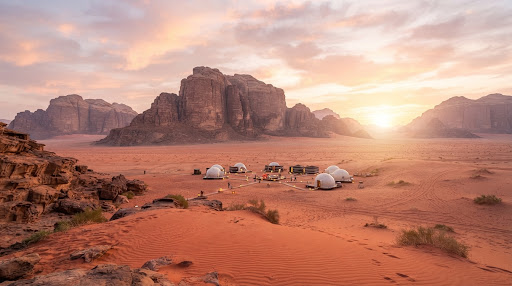
T. E. Lawrence called it "vast, echoing and god-like", and nobody has improved on the description. Wadi Rum is 720 square kilometres of protected desert in southern Jordan — sandstone and granite mountains rising straight out of red sand, home to the Zalabia Bedouin, and a UNESCO World Heritage site.
Almost everyone stays a night. Here is how to choose where, and what nobody tells you before you go.
Choosing a camp
Broadly there are three kinds, and the right one depends entirely on what you want from the night.
- chevron_rightTraditional Bedouin camps. Goat-hair tents, rugs, shared bathroom blocks, dinner around a fire. The most authentic and the most sociable — you will end up drinking tea with your hosts.
- chevron_rightBubble or dome camps. Transparent-roofed pods with private bathrooms and air conditioning, angled so you can lie in bed and watch the stars. Comfortable, photogenic, and popular with honeymooners.
- chevron_rightLuxury tented suites. Proper beds, en-suite bathrooms, served dinners, and enough insulation to be comfortable in winter.
Whichever you choose, camps sit deep inside the protected area — you leave the vehicle road behind and arrive by 4x4 across open sand.
The jeep tour
The standard excursion runs about two hours in an open Bedouin pickup, and covers the landscape's greatest hits: Lawrence's Spring on the flank of Jebel Rum, Khazali Canyon with its Nabataean and Thamudic petroglyphs cut into the walls, the great red dunes you can run down barefoot, and a natural rock bridge or two. It finishes at a sunset point, when the sandstone goes from orange to deep crimson in about twenty minutes.
Longer half- and full-day tours reach further into the reserve, and camel rides, scrambling routes and technical climbs can all be arranged.
Zarb, the desert oven
Dinner at most camps is zarb: chicken, lamb and vegetables layered into a metal frame, lowered into a pit in the sand over hot coals, buried, and left to steam for hours. The unearthing is a small ceremony in itself. The meat falls apart, and it tastes faintly of woodsmoke and sand.
The stars
This is the real reason to stay the night. There is essentially no light pollution for tens of kilometres, the air is bone dry, and on a moonless night the Milky Way is not a smudge but a structure — bright enough to read the shape of the mountains by. Check the moon phase when you book; a full moon is beautiful but it washes out everything else.
Good to know
The desert gets cold. Even after a 35°C afternoon the temperature can fall sharply after dark, and winter nights approach freezing. Bring a fleece and long trousers whatever the season — this catches out almost every first-timer.
What to pack
- chevron_rightWarm layers for the evening, however hot the day has been.
- chevron_rightClosed shoes — sand gets everywhere, and rocks are sharp.
- chevron_rightA headtorch. Camps are lit, but the walk to your tent may not be.
- chevron_rightA power bank; electricity at traditional camps is often limited to certain hours.
- chevron_rightA scarf for wind and dust, useful and easily bought locally.
- chevron_rightCash. There are no ATMs in the reserve.
- chevron_rightModest clothing out of respect for your Bedouin hosts — shoulders and knees covered.
When to go
Spring and autumn are ideal. Midsummer days are punishing in open desert, and midwinter nights are properly cold — though a clear, cold winter night also delivers the sharpest stars of the year. One night suits most travellers; hikers and climbers should give it two.
Travel this with us
Our Serenity Seeker and Adventure Enthused journeys both include a night in Wadi Rum with a two-hour Bedouin jeep tour before the road drops to Aqaba.